Monday, February 6, 2012

Work in Progress: Dancing Tulip III, and the Start of a New Rose Painting

I took a break from the yellow rose painting so that I can go back to it later with a fresh eye, and worked a little more on one of my tulip paintings, mostly painting the various pedal shapes with shades of magenta and rose colors. It's going very slowly, since I am trying to get more control on rough paper -- lifting is hard so I am trying to be more careful with each application. Working in a more defined color scheme -- magenta red vs. yellow green -- makes me more confident about how it would finally turn out. I think I am definitely learning to plan ahead on colors after the numerous trials and errors for the yellow rose...


Dancing Tulip III,  Watercolor on Arches 140# Rough Press Paper , 7"h x 5"w, WIP 2

I've also started another rose painting, this time in a red vs. blue-green color scheme. I thought I'd paint the pedals with glazes of red to gradually reach the color depth, while in the mean time retaining more control of where I want each tint of color to go. But I want to do wet-in-wet in the background leaves to achieve a more out-of-focus look as contrast to the main flower. I painted one pedal to almost completion first, and then the rest are just first washes. I want to develop the whole flower to the same stage of completion, not finish pedal by pedal, but I do want to have at least one in place so that I can compare the other ones to it to decide whether the intensity and value of colors need more work at each stage... We'll see how it goes. Again, this is on soft Lanaquarelle #140 Cold Press paper, so I have to be very careful with glazes, not to saturate the paper with pigment too fast, not to leave a darker, shiny reflective ring at the edge of each wash... Hopefully I've learned these lessons in my last painting. Now let's see if I could avoid making the same mistake a second time... 


Summer Wakening,  
Watercolor on Lanaquarelle 140# Cold Press Press Paper , 10"h x 8"w, WIP 1

Sunday, February 5, 2012

Work in Progress: Lessons Learned from Yellow Rose

Have you ever been in the middle of a painting, and realizing that nothing seems to be working, and you are absolutely hating it? Well, I've reached this stage when trying to finish my "Yellow Rose" today with a few glazes of yellows. Sounds simple enough, isn't it? I thought it would be just a couple of hours' work, even considering the snail speed I usually work at...

...Not so, apparently.

I was painting on a beautifully soft, white paper -- Lanaquarelle #140 Cold Press. It has great handling quality -- pigments granulate beautifully on it, sinks in a little but not too much, makes it possible for lifting but not lifting too easily. I have underpainted the shadow parts of the rose with various amounts of Cobalt Blue, Permanent Rose and Cobalt Violet, which appears on paper and beautiful, soft granulation of blues and purples -- blues for the cooler, green-looking shadows and purples for the warmer, brown-looking shadows in the final painting, or so I planned --

When I start to put a coat of Aureolin Yellow, New Gamboge and Quinacridone Gold on top of the underpainting, I realizes that the beautiful, non-staining underpainting just lifts ever so slightly to mix with the yellow, and this makes the color look muddy. To add insult to injury, the yellow pigments (which are all transparent colors) start to chalk up the paper surface when I desperately added more pigment in the attempt to regain saturation. Since this is a soft paper with less absorbency than Arches #140 Cold Press, too much pigments also congest the paper surface. As a result, the paper starts to dry more rapidly when a wet glaze is put on top of the already congested parts, allowing less time to blend colors. Also, a shiny, reflective ring structure starts to develop at the boundary of each wet wash, caused by the pigments on surface floating up by the newly added water, and deposit on the boundary between wet and dry areas.

At one point I almost got up and torn the painting apart in fury. But I finally managed to control the urge, and redrew the entire painting in a smaller format (6" x 6" instead of 8" x 8"). Actually, three times. 

As I was studying watercolor I've read in books again and again that it is difficult to paint yellow object in shadow, since yellow has such a short value range. I've learned different approaches to deal with the "yellow shadow" problem:
  • Paint the shadows on yellow object with colors on the analogous side of yellow, but have longer value range, then finish the entire object with a yellow glaze on top. This approach gives a harmonious look but sometimes makes the shadow look a little too warm. I learned this from master artist Jan Kunz. She often uses a mixture of Permanent Rose, Raw Sienna and Burnt Sienna to paint shadows on yellow roses and poppies, finishing the entire flower with a Cadmium Yellow glaze to tire the light and shadow parts together;
  • Paint the shadow with a staining purple, maybe enhanced with a neutral grey, then glaze on top of it with yellow. I learned this from master artist Kathleen Alexander. She often underpaints the rich golden center of her plumerias with Winsor Violet mixed with a little triad grey, then glaze over it using New Gamboge and Quinacridone Gold;
So, which one is the best for depicting this rose? And how exactly would the final results differ from one another when taking these different approaches? I don't know, and I've not systematically compared them before. Hence, I drew three identical images of the same rose, and the journey of explorations thus began...

...And when it is finished, I will report back for comparisons, if anyone's interested.

Strange as it is, after I decided to treat this painting as a good learning experience, and stop worrying about producing a good finished appearance of it, everything became a little easier, and I actually managed to finish the yellow glazes on the rose. It still does not look exactly like the beautiful image I had in mind when the project started, but it was not half bad as I'd thought it would end up to be:


Yellow Rose,  Watercolor on Lanaquarelle140# Cold Press Paper , 8"h x 8"w, WIP 6

Saturday, February 4, 2012

Island Beauty - White Plumeria (Finished!)

Here it is -- finished and signed! This painting has been a prolonged struggle despite of its small size, and I have to constantly battle the urge to tear it up and burn it -- I had to keep on reminding myself this is a deliberate choice and challenge because I want to paint from an imperfect photo and see if I can translate it into a painting that satisfies me in the design aspect. It has served me as a good exercise, and I liked how it turned out at last.


Island Beauty - White Plumeria,  
Watercolor on Fabriano Artistico 140# Cold Press Paper, 6"h x 6"w, 2012 #12

Bid at My DPW Auction (Starting Bid $125)

Friday, February 3, 2012

Work in Progress: Island Beauty - White Plumeria (Continued)

Here's how it looks after another day's work -- most of the leaves are done, with rich greens created by floating transparent tube greens such as Sap Green and Hooker's Green on top of a very colorful underpainting of reds, blues and browns. I've also added another layer of shadow mixed from three transparent primaries -- Permanent Rose, Cobalt Blue and Aureolin Yellow -- on flower pedals, trying hard to make it still light, comparable to the lighter areas on leaves. I used my red acetate to check value scales often. It's getting close to be done, and I'm crossing my fingers...


Island Beauty - White Plumeria,  
Watercolor on Fabriano Artistico 140# Cold Press Paper , 6"h x 6"w, WIP 2

Thursday, February 2, 2012

Work in Progress: Island Beauty - White Plumeria

...I know, I know, the plan was to paint roses for the days in February before the important Valentines... But life never quite go as how it was planned, was it? ;-P...

What happened was this reference photo caught my eyes when I was flipping through a deck of white rose photos and could not decide which one to pick and paint. The photo of the white plumeria poses an interesting challenge in the following aspects:

To vividly capture the value contrast of light and shadow on a white flower on a sunny day, I have deliberately decreased the exposure time, which made the dark green foliage way to dark to resolve on the photo. However, I really love the beautiful blue-grey shadow patterns on the flower pedals. As a partially solution, I end up adjust the brightness and contrast of the photo to make the leaves in shade more interesting to paint;

After adjust photo brightness, the foliages still look way too grey and it was very hard to tell the hues and temperatures between one leaf and another. I had to increase the saturation of the reference photo in photoshop to make the nuances in color differences more distinguishable;

Since the entire foliage shape is in shadow and their local colors are also much darker than the flower, in the reference photo the entire flower appears as a light shape while the background foliage appears as a dark shape, which makes the flower look slightly cut-and-paste and out of place. I had to try very hard to exaggerate the value difference between different leaf shapes, to make the value patterns in this image more interesting.

I liked these challenges from an interesting but not perfect photo, and decided to give it a try. Since I had to think through many things and do quite a few adjustment of the reference material before putting the brush to paper, I did not get very far in the actual painting:


Island Beauty - White Plumeria,  
Watercolor on Fabriano Artistico 140# Cold Press Paper , 6"h x 6"w, WIP 1

I did the first layer of shadows on the flower with mainly Cobalt Blue, and started to block in the foliages with very exaggerated intense colors -- Peacock Blue, Alizarin Crimson -- to indicate the color temperature difference to myself. Then I washed various greens -- mixed from blue, yellow and some tube greens -- over the underpainting, which created interesting, more muted leaf colors. I am also constantly looking through a piece of red plastic to check to value pattern of the painting, to make sure it's interesting enough, and there are enough value gradations in the foliage. It's really a challenge to paint from a reference photo but not so literally, but I am enjoying the process!

Monday, January 30, 2012

Work in Progress: Summer Heat, Central Valley and Winter Mirage (Master Study)

More landscape practice today... And I have to admit I am more and more hooked. I took out another piece that was started in the same Roland Lee workshop as I mentioned in my last post, and tried negative painting again in the foreground grass land... This time I was quite happy with the result. The almost monochromatic yellow-brown palette was chosen specifically for the impressions I got driving on the winding roads down central valley in the heat of June and July... Every inch in view is burnt by heat. 


Summer Heat, Central Valley,  
Watercolor on Arches #140 Cold Press Paper , 6"h x 9"w, WIP 1

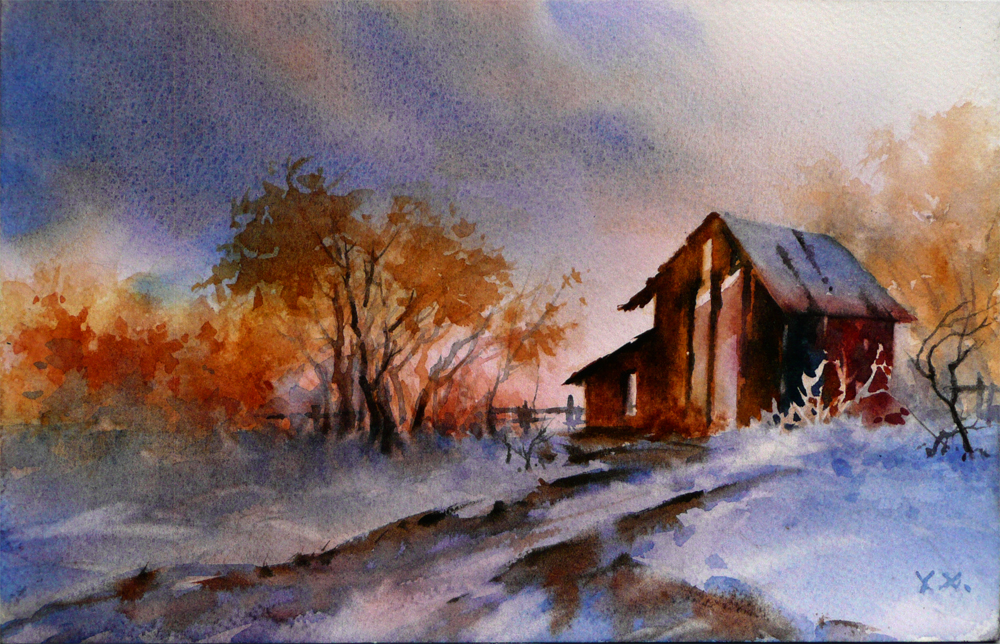
After several hours' careful painting around little shapes, I felt that I needed a change and took out a fresh piece of paper, completely soaked it with water, and laid it on a piece of plexglass, which is non-absorbent and therefore slowed down drying to the minimum. I flooded in the sky and snow colors and charged the bright orange hues when the paper gradually dried. When the paper completely lost its sheen, I dropped in the tree and shrub shapes with smaller, stiff brushes. Until this stage, everything was painted in one wet cycle. I have very little control of the process and cannot lift much without affecting the colors which had been flooded in first. It was very scary, but exciting in the same time! I love watercolor in its free-flowing state...


Winter Mirage, Watercolor on Arches #140 Cold Press Paper , 6"h x 9"w, WIP 1

Sunday, January 29, 2012

First Snow (Something Slightly Different)

This June I took a workshop with a very good landscape watercolor painter, Roland Lee, to study his methods of negative painting. It was not a difficult concept to grasp, and he was an amazing teacher who gives clear, thorough explanations of every "how"s and "why"s. However, when I was sorting through my studio mess, and came across a piece that I started at the workshop, deciding to complete it as a refreshment of what I have learned, I found out that it is really not easy to paint this way -- my mind's eye kept on switching between the positive and negative shapes, and my hands just was not able to paint around the shapes that are suppose to be lighter -- it kept on filling them in!!! I have not painted many landscapes, so this one, although simple, has been a true struggle for me. I am also feeling a bit confined by the limited palette of blues and browns... But I felt that it was needed to create the slight melancholic end of fall, beginning of winter feel. 

It was suppose to be a quick piece but it turned out to be everything but... I guess I do need to practice more landscape painting -- it deals with a whole different set of problems and corresponding solutions. Omission, simplification and suggesting with texture is much more important to landscape painting than to floral and still life paintings. A lot of times landscape painters have to be more liberal with their shape making and mark making, be more indicative than literal... It is difficult for me, but I do love it. After all, practice makes perfect! 


First Snow,  Watercolor on Arches 140# Cold Press Paper , 6"h x 9"w, 2012 #10

Sold!

Saturday, January 28, 2012

Work in Progress: Hide and Seek (Almost Done...) and a New Tulip Painting

A very busy day today... Not a lot of time available for painting, but I finally managed to squeeze in some after sun down. More work on "Hide and Seek" which I wish to finish today but finally did not manage to do. However, I did gather all the courage and attached one of the parts I considered most difficult for this one -- the out of focus leaves in front of the flower. I am quite happy about the out of focus look generated by the wet in wet brushwork and lifting. I love the color blending and mingling on paper making colorful greys. Fabriano Artistico Cold Press paper is wonderful in generating granulating and other wonderful results when being painted on wet-in-wet, however, since color lifts easily from this paper, for darker passages you mostly just get one shot for each region -- everything has to be completed before the paper dries, it is a bit nerve-wrecking... I'm just glad each time it turns out OK.


Hide and Seek,  Watercolor on Fabriano Artistico 140# Cold Press Paper , 5"h x 7"w, WIP 8

Since I have the habit of pairing the finish of a painting with the start of another one, switching between loose application of underpainting and/or background colors, and tight handling of the finishing detail works, I began another tulip painting today. Half way into whipping various blues, greens and purples onto soaking wet paper, I realized that I have the habit of painting the dark background before my subject. I stopped to contemplate the possible reason for forming this unconscious habit -- Is it because I am secretly very nervous about the wet-into-wet dark backgrounds, and worry that I might ruin a whole finished painting if not getting them in first? Is it because of my method of painting -- by painting the dark regions first, I can correct and hard edges or inaccurate shapes by lifting colors off the boundary between the darks and the unpainted white regions, which would not be possible if the subject has already been painted in? The traditional watercolor method is painting from light to dark. My habit is obviously opposite to the norm -- or is it? How do other artists approach a light subject on a dark background?... 


Dancing Tulip III,  Watercolor on Arches 140# Rough Press Paper , 7"h x 5"w, WIP 1

Friday, January 27, 2012

Work in Progress: Hide and Seek, and a Little More Work on Sun Dance

"Hide and Seek" is progressing steadily, I hope I could finish it tomorrow. At this stage, I am adding form shadows and cast shadows by first wet the pedal I want to paint with clear water, then drop in relatively dry pigments mixed with Quinacridone Magenta, Alizarin Crimson and Winsor Violet. To achieve the desired value, sometimes I would mix in a little Lamp Black or Ivory Black too. I am deliberately going very slow, not wanting to make any mistake


Hide and Seek,  Watercolor on Fabriano Artistico 140# Cold Press Paper , 5"h x 7"w, WIP 6


Hide and Seek,  Watercolor on Fabriano Artistico 140# Cold Press Paper , 5"h x 7"w, WIP 7

In between drying cycles I also managed to do a little more work on the yellow rose painting, "Sun Dance", continuing on the shadows of flower pedals. I've also started on the underpainting of the background, starting from the darkest areas, mix and mingling many pure, high intensity colors. I want the background to have a glowing, colorful look. If it turns out too garish in the end, I can always opt to paint them out with a juicy wet-in-wet dark passage.


Sun Dance,  Watercolor on Arches 140# Cold Press Paper , 8"h x 8"w, WIP 2


Thursday, January 26, 2012

Spring Breeze II (Finished!), and the Start of a New Orchid Painting

Have you ever felt that the last 10% of a painting always takes forever to finish? I literally worked on "Spring Breeze II" for the whole day today! True, there is only the flower in the center of focus to be completed, but that has taken forever... I think the outer most pedal on the right may still needs some work, but I decided to call it finished for now -- waking up with a fresh eye is generally better for evaluation of whether there is anything left to be done on a painting, and not doing so have costed me dearly before. So, here it is:


Spring Breeze II,  Watercolor on Arches 140# Rough Paper , 7"h x 5"w, 2012 #9

Sold!

I found out that colors do not appear as brilliant on rough paper, which is a problem. On the other hand, I really like the velvety look of the tulip pedals -- which is characteristic of thickly layered passages on rough paper. Pros, cons, well, maybe I will give this paper another try...

Since I was only working on a small section of this painting, I had to wait for the paper to dry each time I add a color passage. So, in between drying time I started this little painting of an orchid. I tried out some granulating pigment combinations for the shadows on the pedal -- Cerulean Blue, Cobalt Violet and Aureolin Yellow. I loved the results. The veins of pedals were pure Cobalt Violet, and the patters on the inner pedals were a mixture of Permanent Rose, Opera Rose and Cobalt Violet.

For the background, I did not do my usual wet in wet song and dance. Instead, I decided to try out a method I recently learned from a book written by the fabulous artist, Thomas Aquinas Daly -- layering alternatively warm and cool colors and watch closely to control the hue, value and temperature of each area. The layered paints has formed some interesting subtle textures that I want to keep... We'll see.


Dancing Orchid,  Watercolor on Fabriano Artistico #140 Cold Press Paper , 6"h x 6"w, WIP 1

Related Posts Plugin for WordPress, Blogger...